As Banff, Jasper, and the Canadian Rockies, in general, become more and more popular, it’s important for visitors to keep in mind the 7 Leave No Trace Principles as they explore this stunning place. These principles are important because they help to protect wildlife, wild spaces, and nature itself, so we can enjoy it for many years to come and live harmoniously with wildlife instead of harming it.
The main goal of Leave No Trace is to encourage people to be more aware of their surroundings as they adventure, think about the impact they are having, and preserve nature as much as possible while still enjoying the outdoors.
The Seven Leave No Trace Principles

1. Plan Ahead and Prepare
- Bring or rent bear spray to use while hiking
- Use public transport to visit super popular spots if you really don’t want to miss them. Public transport is available in Banff through ROAM Transit, and Jasper has a small public transit system. There is no public transit between Banff and Jasper.
- Have a back-up plan in case parking is full (and don’t park on the grass – it wrecks it!)
- Be prepared for hikes by having proper gear, enough food and water, and a map of the trail
- Do your research beforehand –
- Some hikes require more experience than others (some may have scrambles or require poles)
- Some roads close in the Rockies depending on the season
- Some hikes require a minimum number of hikers in your group due to bear activity
- There are a lot of zones in and around the National Parks that have no service (Kananaskis Country, the Icefields Parkway, etc.). Make sure to download everything you will need so it is accessible offline, or bring a paper copy of anything you need.

2. Travel and Camp on Durable Surfaces
- Parks Canada has implemented some viewing platforms in order to help prevent erosion and maintain beautiful viewpoints. Please be respectful and stay on these designated platforms. An example of one of these viewpoints is Peyto Lake/Bow Summit. Even though you might see others going off the path, please do your part and admire the beauty from the platform. If you don’t want other people in your photo, go early in the day or in the evening during the week!
- When camping, always pitch your tent on the gravel part of the campsite or on the designated tent pad, not on grass or alpine flora.
- When hiking, stay on the trail and do not crush the fragile alpine environment by going off trail. Even if it looks like there is a designated trail, sometimes there will be signs asking you to stay off, because they are trying to restore crushed vegetation in that area.

3. Dispose of Waste Properly
- On day hikes, make sure to bring a little bag to keep your garbage in and carry it with you until you find a proper, bear-proof garbage can.
- Make sure to properly latch bear-proof garbage cans.
- Don’t throw food in the fire pit – this will attract birds and other wildlife.
- If a garbage can is full, carry your trash with you until you find one that will close properly and latch.
- Use outhouses if you have to go to the bathroom, there is one at almost every viewpoint in the park, most trailheads, as well as washrooms in the Towns themselves (free of cost).
- Do not toss garbage down the outhouse toilet. Pack it out and dispose of it in a bear-proof garbage can.
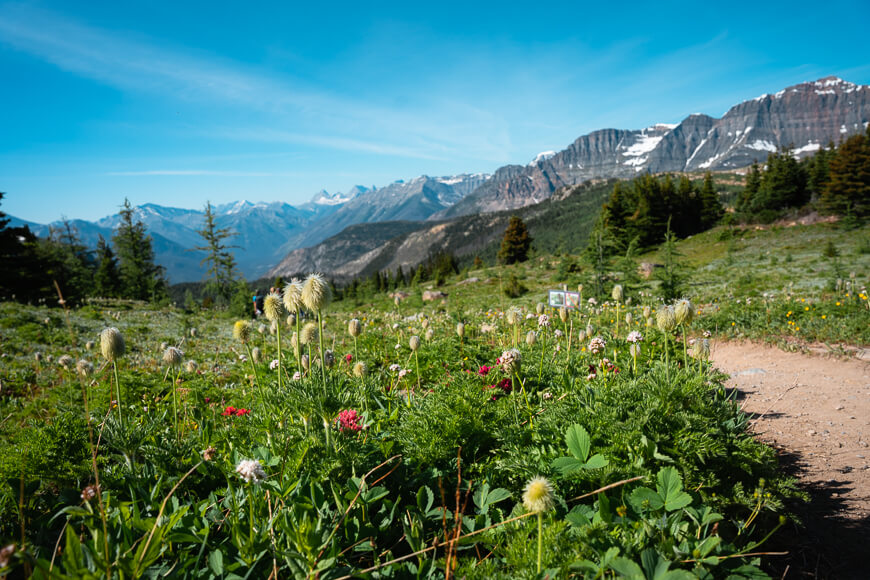
4. Leave What You Find
- Please don’t rip up or destroy wildflowers. This includes stepping on them to get a cool photo! Please stay on the trails and try to use camera angles in order to get the photo you envisioned instead.
- Don’t carve up rocks or nail things into trees.
- Removing natural objects can negatively impact the animals that call this place their home!

5. Minimize Campfire Impacts
- Keep your campfire in the designated fire ring.
- Use the wood provided to you by Parks Canada, and do not bring in your own firewood (risk of pests and invasive species!)
- Never leave your fire unattended.
- If leaving your fire, make sure to pour water all over it, stir it up, and pour more water on it until it is fully extinguished.
- Respect fire bans if there is one. If you are unsure, ask someone from Parks Canada and they will let you know.

6. Respect Wildlife
- Do not try and feed the wildlife – this causes them to learn that humans will provide food. Animals will start to rely on humans for food and they could turn aggressive as they associate humans with high-calorie food, or cause animals to start invading campgrounds and towns in search of food.
- Do not get out of your car to get closer to animals!!! Stay in your car and view them from a safe distance.
- Do not speed while driving – animals can pop out from the trees at any moment, and so many unnecessary animal deaths happen in National Parks because of speeding.
- If you see an animal while hiking, keep your distance and be respectful. If they are showing signs that they are on alert, you are probably too close. Read up on bear safety and what to do if you encounter a bear while hiking, before leaving on your hike.
- If you see animals on or near the road, drive slowly with your hazards on or wait for them to pass. Report any animal sightings to Parks Canada so they can keep these animals safe.
- If camping, never leave food out and unattended (including your cooler). This will attract wildlife, including bears! If you are not directly near it, keep any scented objects in your vehicle – this includes toothpaste and hand lotion! In the summer of 2022, a camper left a pan out on the picnic table at a nearby campground and a bear found it, and then started going around pawing at trailers and tents in search of more food. Now the bear is being monitored and its life may be at risk due to this camper’s mistake.

7. Be Considerate of Others
- The Canadian Rockies are BUSY. Everyone wants a pretty photo and everyone wants to enjoy the beauty the Rockies have to offer. Be respectful and aware of other travelers!
- Keep music to a low – a lot of people like to get out in nature for the peace and quiet, not to hear someone blasting their music on the trail or at camp.
- Canadian National Parks and a lot of provincial parks are No Drone Zones. Please do not fly your drone here! There is also a huuuge fine associated with flying your drone in a No Drone Zone.
- You may see a beautiful field of flowers on the side of the road or while hiking in wildflower season. Keep in mind that some flowers on the sides of highways may be someone’s livelihood/crop, and you crushing everything just to snap a photo probably isn’t the best choice. Fields of wildflowers are an important food source for animals and bugs that live here, as well as an important part of the ecosystem. Destroying them and crushing them isn’t the way to go. Please stay on the trail and try different camera angles if you’re after a nice picture – and maybe even do your research on nice trails to snap wildflower photos before setting out if you really want one.
It’s so incredibly important to Leave No Trace and reduce the impact we have on the environment, both in the Canadian Rockies and everywhere else on Earth. Not everyone may be aware of the Leave No Trace Principles, so please be respectful and educate with good intentions!
Why Are The Leave No Trace Principles Important?

1. To Keep Animals Wild
I have seen bear-proof trash cans overflowing in parks, which defeats the purpose of being bear-proof. If bears or other wildlife start to venture into high-trafficked areas, such as parking lots or even Towns, it is the animal’s life on the line. Animals will start to turn aggressive or venture into these areas more if they know they can get high-calorie food in these places, and unfortunately, Parks Canada will have to put down the animal if it comes to it.
Feeding smaller critters like squirrels, chipmunks, and birds can cause these animals to associate humans with easy food, and they will start to have pest-like behavior. They will try to steal food when you’re having a picnic or raid your bag when you’re not looking. Overall it’s not good for the critters and it’s not a great experience for the humans either.

2. To Maintain Beautiful Places in The Age of Social Media
As social media picks up, sharing locations can cause more harm than good. A high influx of visitors to a location that isn’t prepared for it can cause a lot of damage.
Try to be considerate when sharing locations and evaluate the infrastructure of places you want to share. I’m trying to work on this as well, as it can be hard to decide whether or not a place can handle a large influx of visitors.
Typically if it’s already a well-known location, with parking, washrooms, bear-proof garbage cans, etc. it’s okay to share. If it’s a turn-out on the side of the road and can’t hold a lot of people – maybe it’s not the best idea to share. Even if you don’t have a lot of followers, you don’t know what the future might hold or who else might come across your post.

3. So We Can Enjoy These Amazing Places Now and in the Future
Getting out in nature is such a fantastic activity, and we want to be able to enjoy it in the future, as well as let future generations enjoy it too. If a place becomes too highly trafficked and is getting destroyed due to human impact, Parks Canada will close the area either for maintenance or permanently. This will make these spaces harder to enjoy or even become impossible to visit in the future. It would suck if you saved for an entire year to go on your bucket list trip here, just to find out a bunch of hiking trails and spots are closed.
Do your part while you can – every little bit counts, and remember we are a guest in these wild places!

Did you know all of these Leave No Trace Principles? Let me know!
Find me on: Instagram | Pinterest | Youtube
More on the Rockies:
- Banff National Park Bucket List
- Jasper National Park Bucket List
- Easy Hikes Near Banff National Park
- 4 Day Banff Itinerary
- Moraine Lake Tips For Visiting
Pin This:



Hey! I’m Kat. Based in Alberta, Canada and just 4 hours from the Canadian Rocky Mountains, I love to travel to Banff and Jasper frequently and also explore new places around the world. Follow along for my tips based on my real adventures!